Hot Topic News & Current Events

What's Happening and What's on our minds about It.

Tuesday, September 26, 2006

Strings Attached


UNSTRUNG
by JIM HOLT
In string theory, beauty is truth, truth beauty. Is that really all we need to know?
Issue of 2006-10-02
Posted 2006-09-25

It is the best of times in physics. Physicists are on the verge of obtaining the long-sought Theory of Everything. In a few elegant equations, perhaps concise enough to be emblazoned on a T-shirt, this theory will reveal how the universe began and how it will end. The key insight is that the smallest constituents of the world are not particles, as had been supposed since ancient times, but “strings”—tiny strands of energy. By vibrating in different ways, these strings produce the essential phenomena of nature, the way violin strings produce musical notes. String theory isn’t just powerful; it’s also mathematically beautiful. All that remains to be done is to write down the actual equations. This is taking a little longer than expected. But, with almost the entire theoretical-physics community working on the problem—presided over by a sage in Princeton, New Jersey—the millennia-old dream of a final theory is sure to be realized before long.

It is the worst of times in physics. For more than a generation, physicists have been chasing a will-o’-the-wisp called string theory. The beginning of this chase marked the end of what had been three-quarters of a century of progress. Dozens of string-theory conferences have been held, hundreds of new Ph.D.s have been minted, and thousands of papers have been written. Yet, for all this activity, not a single new testable prediction has been made, not a single theoretical puzzle has been solved. In fact, there is no theory so far—just a set of hunches and calculations suggesting that a theory might exist. And, even if it does, this theory will come in such a bewildering number of versions that it will be of no practical use: a Theory of Nothing. Yet the physics establishment promotes string theory with irrational fervor, ruthlessly weeding dissenting physicists from the profession. Meanwhile, physics is stuck in a paradigm doomed to barrenness.

So which is it: the best of times or the worst of times? This is, after all, theoretical physics, not a Victorian novel. If you are a casual reader of science articles in the newspaper, you are probably more familiar with the optimistic view. But string theory has always had a few vocal skeptics. Almost two decades ago, Richard Feynman dismissed it as “crazy,” “nonsense,” and “the wrong direction” for physics. Sheldon Glashow, who won a Nobel Prize for making one of the last great advances in physics before the beginning of the string-theory era, has likened string theory to a “new version of medieval theology,” and campaigned to keep string theorists out of his own department at Harvard. (He failed.)

Now two members of the string-theory generation have come forward with exposés of what they deem to be the current mess. “The story I will tell could be read by some as a tragedy,” Lee Smolin writes in “The Trouble with Physics: The Rise of String Theory, the Fall of a Science, and What Comes Next” (Houghton Mifflin; $26). Peter Woit, in “Not Even Wrong: The Failure of String Theory and the Search for Unity in Physical Law” (Basic; $26.95), prefers the term “disaster.” Both Smolin and Woit were journeyman physicists when string theory became fashionable, in the early nineteen-eighties. Both are now outsiders: Smolin, a reformed string theorist (he wrote eighteen papers on the subject), has helped found a sort of Menshevik cell of physicists in Canada called the Perimeter Institute; Woit abandoned professional physics for mathematics (he is a lecturer in the mathematics department at Columbia), which gives him a cross-disciplinary perspective. Each author delivers a bill of indictment that is a mixture of science, philosophy, aesthetics, and, surprisingly, sociology. Physics, in their view, has been overtaken by a cutthroat culture that rewards technicians who work on officially sanctioned problems and discourages visionaries in the mold of Albert Einstein. Woit argues that string theory’s lack of rigor has left its practitioners unable to distinguish between a scientific hoax and a genuine contribution. Smolin adds a moral dimension to his plaint, linking string theory to the physics profession’s “blatant prejudice” against women and blacks. Pondering the cult of empty mathematical virtuosity, he asks, “How many leading theoretical physicists were once insecure, small, pimply boys who got their revenge besting the jocks (who got the girls) in the one place they could—math class?”

It is strange to think that such sordid motives might affect something as pure and objective as physics. But these are strange days in the discipline. For the first time in its history, theory has caught up with experiment. In the absence of new data, physicists must steer by something other than hard empirical evidence in their quest for a final theory. And that something they call “beauty.” But in physics, as in the rest of life, beauty can be a slippery thing.


The gold standard for beauty in physics is Albert Einstein’s theory of general relativity. What makes it beautiful? First, there is its simplicity. In a single equation, it explains the force of gravity as a curving in the geometry of space-time caused by the presence of mass: mass tells space-time how to curve, space-time tells mass how to move. Then, there is its surprise: who would have imagined that this whole theory would flow from the natural assumption that all frames of reference are equal, that the laws of physics should not change when you hop on a merry-go-round? Finally, there is its aura of inevitability. Nothing about it can be modified without destroying its logical structure. The physicist Steven Weinberg has compared it to Raphael’s “Holy Family,” in which every figure on the canvas is perfectly placed and there is nothing you would have wanted the artist to do differently.

Einstein’s general relativity was one of two revolutionary innovations in the early part of the twentieth century which inaugurated the modern era in physics. The other was quantum mechanics. Of the two, quantum mechanics was the more radical departure from the old Newtonian physics. Unlike general relativity, which dealt with well-defined objects existing in a smooth (albeit curved) space-time geometry, quantum mechanics described a random, choppy microworld where change happens in leaps, where particles act like waves (and vice versa), and where uncertainty reigns.

In the decades after this dual revolution, most of the action was on the quantum side. In addition to gravity, there are three basic forces that govern nature: electromagnetism, the “strong” force (which holds the nucleus of an atom together), and the “weak” force (which causes radioactive decay). Eventually, physicists managed to incorporate all three into the framework of quantum mechanics, creating the “standard model” of particle physics. The standard model is something of a stick-and-bubble-gum contraption: it clumsily joins very dissimilar kinds of interactions, and its equations contain about twenty arbitrary-seeming numbers—corresponding to the masses of the various particles, the ratios of the force strengths, and so on—that had to be experimentally measured and put in “by hand.” Still, the standard model has proved to be splendidly useful, predicting the result of every subsequent experiment in particle physics with exquisite accuracy, often down to the eleventh decimal place. As Feynman once observed, that’s like calculating the distance from Los Angeles to New York to within a hairbreadth.

The standard model was hammered out by the mid-nineteen-seventies, and has not had to be seriously revised since. It tells how nature behaves on the scale of molecules, atoms, electrons, and on down, where the force of gravity is weak enough to be overlooked. General relativity tells how nature behaves on the scale of apples, planets, galaxies, and on up, where quantum uncertainties average out and can be ignored. Between the two theories, all nature seems to be covered. But most physicists aren’t happy with this division of labor. Everything in nature, after all, interacts with everything else. Shouldn’t there be a single set of rules for describing it, rather than two inconsistent sets? And what happens when the domains of the two theories overlap—that is, when the very massive is also the very small? Just after the big bang, for example, the entire mass of what is now the observable universe was packed into a volume the size of an atom. At that tiny scale, quantum uncertainty causes the smooth geometry of general relativity to break up, and there is no telling how gravity will behave. To understand the birth of the universe, we need a theory that “unifies” general relativity and quantum mechanics. That is the theoretical physicist’s dream.


String theory came into existence by accident. In the late nineteen-sixties, a couple of young physicists thumbing through mathematics books came upon a centuries-old formula that, miraculously, seemed to fit the latest experimental data about elementary particles. At first, no one had a clue why this should be. Within a few years, however, the hidden meaning of the formula emerged: if elementary particles were thought of as tiny wriggling strings, it all made sense. What were these strings supposed to be made of? Nothing, really. As one physicist put it, they were to be thought of as “tiny one-dimensional rips in the smooth fabric of space.”

This wasn’t the only way in which the new theory broke with previous thinking. We seem to live in a world that has three spatial dimensions (along with one time dimension). But for string theory to make mathematical sense the world must have nine spatial dimensions. Why don’t we notice the six extra dimensions? Because, according to string theory, they are curled up into some microgeometry that makes them invisible. (Think of a garden hose: from a distance it looks one-dimensional, like a line; up close, however, it can be seen to have a second dimension, curled up into a little circle.) The assumption of hidden dimensions struck some physicists as extravagant. To others, though, it seemed a small price to pay. In Smolin’s words, “String theory promised what no other theory had before—a quantum theory of gravity that is also a genuine unification of forces and matter.”

But when would it make good on that promise? In the decades since its possibilities were first glimpsed, string theory has been through a couple of “revolutions.” The first took place in 1984, when some potentially fatal kinks in the theory were worked out. On the heels of this achievement, four physicists at Princeton, dubbed the Princeton String Quartet, showed that string theory could indeed encompass all the forces of nature. Within a few years, physicists around the world had written more than a thousand papers on string theory. The theory also attracted the interest of the leading figure in the world of theoretical physics, Edward Witten.

Witten, now at the Institute for Advanced Study, in Princeton, is held in awe by his fellow-physicists, who have been known to compare him to Einstein. As a teen-ager, he was more interested in politics than in physics. In 1968, at the age of seventeen, he published an article in The Nation arguing that the New Left had no political strategy. He majored in history at Brandeis, and worked on George McGovern’s 1972 Presidential campaign. (McGovern wrote him a letter of recommendation for graduate school.) When he decided to pursue a career in physics, he proved to be a quick study: Princeton Ph.D., Harvard postdoc, full professorship at Princeton at the age of twenty-nine, MacArthur “genius grant” two years later. Witten’s papers are models of depth and clarity. Other physicists attack problems by doing complicated calculations; he solves them by reasoning from first principles. Witten once said that “the greatest intellectual thrill of my life” was learning that string theory could encompass both gravity and quantum mechanics. His string-theoretic investigations have led to stunning advances in pure mathematics, especially in the abstract study of knots. In 1990, he became the first physicist to be awarded the Fields Medal, considered the Nobel Prize of mathematics.

It was Witten who ushered in the second string-theory revolution, which addressed a conundrum that had arisen, in part, from all those extra dimensions. They had to be curled up so that they were invisibly small, but it turned out that there were various ways of doing this, and physicists were continually finding new ones. If there was more than one version of string theory, how could we decide which version was correct? No experiment could resolve the matter, since string theory concerns energies far beyond those which can be attained by particle accelerators. By the early nineteen-nineties, no fewer than five versions of string theory had been devised. Discouragement was in the air. But the mood improved markedly when, in 1995, Witten announced to an audience of string theorists at a conference in Los Angeles that these five seemingly distinct theories were mere facets of something deeper, which he called “M-theory.” In addition to vibrating strings, M-theory allowed for vibrating membranes and blobs. As for the name of the new theory, Witten was noncommittal; he said that “M stands for magic, mystery, or membrane, according to taste.” Later, he mentioned “murky” as a possibility, since “our understanding of the theory is, in fact, so primitive.” Other physicists have suggested “matrix,” “mother” (as in “mother of all theories”), and “masturbation.” The skeptical Sheldon Glashow wondered whether the “M” wasn’t an upside-down “W,” for Witten.

Today, more than a decade after the second revolution, the theory formerly known as strings remains a seductive conjecture rather than an actual set of equations, and the non-uniqueness problem has grown to ridiculous proportions. At the latest count, the number of string theories is estimated to be something like one followed by five hundred zeros. “Why not just take this situation as a reductio ad absurdum?” Smolin asks. But some string theorists are unabashed: each member of this vast ensemble of alternative theories, they observe, describes a different possible universe, one with its own “local weather” and history. What if all these possible universes actually exist? Perhaps every one of them bubbled into being just as our universe did. (Physicists who believe in such a “multiverse” sometimes picture it as a cosmic champagne glass frothing with universe-bubbles.) Most of these universes will not be biofriendly, but a few will have precisely the right conditions for the emergence of intelligent life-forms like us. The fact that our universe appears to be fine-tuned to engender life is not a matter of luck. Rather, it is a consequence of the “anthropic principle”: if our universe weren’t the way it is, we wouldn’t be here to observe it. Partisans of the anthropic principle say that it can be used to weed out all the versions of string theory that are incompatible with our existence, and so rescue string theory from the problem of non-uniqueness.

Copernicus may have dislodged man from the center of the universe, but the anthropic principle seems to restore him to that privileged position. Many physicists despise it; one has depicted it as a “virus” infecting the minds of his fellow-theorists. Others, including Witten, accept the anthropic principle, but provisionally and in a spirit of gloom. Still others seem to take perverse pleasure in it. The controversy among these factions has been likened by one participant to “a high-school-cafeteria food fight.”

In their books against string theory, Smolin and Woit view the anthropic approach as a betrayal of science. Both agree with Karl Popper’s dictum that if a theory is to be scientific it must be open to falsification. But string theory, Woit points out, is like Alice’s Restaurant, where, as Arlo Guthrie’s song had it, “you can get anything you want.” It comes in so many versions that it predicts anything and everything. In that sense, string theory is, in the words of Woit’s title, “not even wrong.” Supporters of the anthropic principle, for their part, rail against the “Popperazzi” and insist that it would be silly for physicists to reject string theory because of what some philosopher said that science should be. Steven Weinberg, who has a good claim to be the father of the standard model of particle physics, has argued that anthropic reasoning may open a new epoch. “Most advances in the history of science have been marked by discoveries about nature,” he recently observed, “but at certain turning points we have made discoveries about science itself.”


Is physics, then, going postmodern? (At Harvard, as Smolin notes, the string-theory seminar was for a time actually called “Postmodern Physics.”) The modern era of particle physics was empirical; theory developed in concert with experiment. The standard model may be ugly, but it works, so presumably it is at least an approximation of the truth. In the postmodern era, we are told, aesthetics must take over where experiment leaves off. Since string theory does not deign to be tested directly, its beauty must be the warrant of its truth.

In the past century, physicists who have followed their aesthetic sense in the absence of experimental data seem to have done quite well. As Paul Dirac said, “Anyone who appreciates the fundamental harmony connecting the way Nature runs and general mathematical principles must feel that a theory with the beauty and elegance of Einstein’s theory has to be substantially correct.” The idea that “beauty is truth, truth beauty” may be a beautiful one, but is there any reason to think it is true? Truth, after all, is a relationship between a theory and the world, whereas beauty is a relationship between a theory and the mind. Perhaps, some have conjectured, a kind of cultural Darwinism has drilled it into us to take aesthetic pleasure in theories that are more likely to be true. Or perhaps physicists are somehow inclined to choose problems that have beautiful solutions rather than messy ones. Or perhaps nature itself, at its most fundamental level, possesses an abstract beauty that a true theory is bound to mirror. What makes all these explanations suspect is that standards of theoretical beauty tend to be ephemeral, routinely getting overthrown in scientific revolutions. “Every property that has at some date been seen as aesthetically attractive in theories has at other times been judged as displeasing or aesthetically neutral,” James W. McAllister, a philosopher of science, has observed.

The closest thing to an enduring mark of beauty is simplicity; Pythagoras and Euclid prized it, and contemporary physicists continue to pay lip service to it. All else being equal, the fewer the equations, the greater the elegance. And how does string theory do by this criterion? Pretty darn well, one of its partisans has facetiously observed, since the number of defining equations it has so far produced remains precisely zero. At first, string theory seemed the very Tao of simplicity, reducing all known particles and forces to the notes of a vibrating string. As one of its pioneers commented, “String theory was too beautiful a mathematical structure to be completely irrelevant to nature.” Over the years, though, it has repeatedly had to be jury-rigged in the face of new difficulties, so that it has become a Rube Goldberg machine—or, rather, a vast landscape of them. Its proponents now inveigh against what they call “the myth of uniqueness and elegance.” Nature is not simple, they maintain, nor should our ultimate theory of it be. “A good, honest look at the real world does not suggest a pattern of mathematical minimality,” says the Stanford physicist Leonard Susskind, who seems to have no regrets about string theory’s having “gone from being Beauty to the Beast.”

If neither predictive value nor beauty explains the persistence of string theory, then what does? Since the late eighteenth century, no major scientific theory has been around for more than a decade without getting a thumbs-up or a thumbs-down. Correct theories nearly always triumph quickly. But string theory, in one form or another, has been hanging on inconclusively for more than thirty-five years. Einstein’s own pursuit of a unified theory of physics in the last three decades of his life is often cited as a case study in futility. Have a thousand string theorists done any better?


The usual excuse offered for sticking with what increasingly looks like a failed program is that no one has come up with any better ideas for unifying physics. But Smolin and Woit have a different explanation, one that can be summed up in the word “sociology.” Both are worried that academic physics has become dangerously like what the social constructivists have long charged it with being: a community that is no more rational or objective than any other group of humans. String theorists dominate the country’s top physics departments. At the Institute for Advanced Study, the director and nearly all of the particle physicists with permanent positions are string theorists. Eight of the nine MacArthur fellowships awarded to particle physicists over the years have gone to string theorists. Since the fall-off in academic hiring in the nineteen-seventies, the average age of tenured physics professors has reached nearly sixty. Every year, around eighty people receive Ph.D.s in particle physics, but only around ten of them can expect to get permanent jobs in the field. In this hypercompetitive environment, the only hope for a young theoretical physicist is to curry favor by solving a set problem in string theory. “Nowadays,” one established figure in the field has said, “if you’re a hot-shot young string theorist you’ve got it made.”

Both authors also detect a cultlike aspect to the string-theory community, with Witten as the guru. Perhaps, it has been joked, physicists might have an easier time getting funding from the Bush Administration if they represented string theory as a “faith-based initiative.” Smolin deplores what he considers to be the shoddy scientific standards that prevail in the string-theory community, where long-standing but unproved conjectures are assumed to be true because “no sensible person”—that is, no member of the tribe—doubts them. The most hilarious recent symptom of string theory’s lack of rigor is the so-called Bogdanov Affair, in which French twin brothers, Igor and Grichka Bogdanov, managed to publish egregiously nonsensical articles on string theory in five peer-reviewed physics journals. Was it a reverse Sokal hoax? (In 1996, the physicist Alan Sokal fooled the editors of the postmodern journal Social Text into publishing an artful bit of drivel on the “hermeneutics of quantum gravity.”) The Bogdanov brothers have indignantly denied it, but even the Harvard string-theory group was said to be unsure, alternating between laughter at the obviousness of the fraud and hesitant concession that the authors might have been sincere.

These two books present the case against string theory with wit and conviction, though Smolin’s book is by far the more lucid and accessible. Woit has too many pages full of indigestible sentences like “The Hilbert space of the Wess-Zumino-Witten model is a representation not only of the Kac-Moody group, but of the group of conformal transformations as well.” (Distressingly, he goes on to confess that this is “a serious oversimplification.”) Let’s assume that the situation in theoretical physics is as bad as Smolin and Woit say it is. What are non-physicists supposed to do about it? Should we form a sort of children’s crusade to capture the holy land of physics from the string-theory usurpers? And whom should we install in their place?

Smolin furnishes the more definite answer. The current problem with physics, he thinks, is basically a problem of style. The initiators of the dual revolution a century ago—Einstein, Bohr, Schrödinger, Heisenberg—were deep thinkers, or “seers.” They confronted questions about space, time, and matter in a philosophical way. The new theories they created were essentially correct. But, Smolin writes, “the development of these theories required a lot of hard technical work, and so for several generations physics was ‘normal science’ and was dominated by master craftspeople.” Today, the challenge of unifying those theories will require another revolution, one that mere virtuoso calculators are ill-equipped to carry out. “The paradoxical situation of string theory—so much promise, so little fulfillment—is exactly what you get when a lot of highly trained master craftspeople try to do the work of seers,” Smolin writes.

The solution is to cultivate a new generation of seers. And what, really, is standing in the way of that? Einstein, after all, didn’t need to be nurtured by the physics establishment, and Smolin gives many examples of outsider physicists in the style of Einstein, including one who spent ten years in a rural farmhouse successfully reinterpreting general relativity. Neither Smolin nor Woit calls for the forcible suppression of string theory. They simply ask for a little more diversity. “We are talking about perhaps two dozen theorists,” Smolin says. This is an exceedingly modest request, for theoretical physics is the cheapest of endeavors. Its practitioners require no expensive equipment. All they need is legal pads and pencils and blackboards and chalk to ply their trade, plus room and board and health insurance and a place to park their bikes. Intellectually daunting as the crisis in physics may be, its practical solution would seem to demand little more than the annual interest on the rounding error of a Google founder’s fortune.

“How strange it would be if the final theory were to be discovered in our own lifetimes!” Steven Weinberg wrote some years ago, adding that such a discovery would mark the sharpest discontinuity in intellectual history since the beginning of modern science, in the seventeenth century. Of course, it is possible that a final theory will never be found, that neither string theory nor any of the alternatives mentioned by Smolin and Woit will come to anything. Perhaps the most fundamental truth about nature is simply beyond the human intellect, the way that quantum mechanics is beyond the intellect of a dog. Or perhaps, as Karl Popper believed, there will prove to be no end to the succession of deeper and deeper theories. And, even if a final theory is found, it will leave the questions about nature that most concern us—how the brain gives rise to consciousness, how we are constituted by our genes—untouched. Theoretical physics will be finished, but the rest of science will hardly notice.


Check Out My Other Blogs (click on blog name to go there) = / 1.3rd Eye Blog / 2. Favorites Blog/ 3. Vita Excolatur (Living Well ...) Blog/ 4. Humor Me Blog/ 5. News and Current Events Blog/ 6. Consider This ... Blog/ 7. Consumer Warnings Blog/ 8. New Orleans Pentimento Blog/ 9. We Constant Gardeners Blog/ 10. Chaillot Family Blog/

Sunday, September 24, 2006

Casting Couch

‘Shortbus’ Cast Didn’t Study for This in Acting Class


Published: September 24, 2006

IN the crazy and no doubt kinky history of casting calls, there have surely been few like the one for “Shortbus.” It was all about sex, but not because the actors were coming on to the director. And not because the director was looking for big-name hotties to lure audiences into theaters. He wanted people whose sexual histories and hangups might become fodder for the screenplay. He wanted erotically adventurous recruits for an expedition to what he saw as an unexplored confluence of drama, comedy and unblinking pornography.


Photographs by ThinkFilms

From left, the actors Raphael Barker and Sook-Yin Lee with John Cameron Mitchell, director of “Shortbus.”

Readers’ Opinions

Forum: Movies

ThinkFilms

Mr. Mitchell in an improv session with Ms. Lee, left, and Lindsay Beamish.

ThinkFilms

Ms. Lee with Justin Bond in a scene from the film.

And so, on a Web site for what he cryptically called “the sex film project,” the director, John Cameron Mitchell, solicited videotapes “of no longer than 10 minutes of you, the actor, talking about a true-life sexual experience that was very important to you.” Any actor averse to having sex on camera, he added, need not apply.

Raphael Barker applied. On his tape he reminisced about a school trip to Spain when he was 12, and about an older boy there who taught him to masturbate. Sook-Yin Lee applied. On her tape she talked about her struggle to become comfortable enough in her own body to experience sexual pleasure.

For them and the other half dozen other people cast in principal roles in the movie (which opens in New York on Oct. 4), the audition tapes were only the beginning of an odyssey that got no more ordinary — and no less risqué — after that.

The unusual process occasionally blurred the line between reality and illusion. During improvisation workshops and rehearsals with Mr. Mitchell, the writer, director and star of the movie “Hedwig and the Angry Inch,” actors drew on aspects of their own lives to create their characters. Ms. Lee, for example, plays a woman searching for her first orgasm.

While Mr. Mitchell is credited with the final screenplay for “Shortbus,” the cast shares credit with him for the story. From the beginning, he said in a recent interview, “I realized that for the actors not to feel exposed, they would have to be co-creators with me of the piece. So that dictated how we were going to make it.”

To overcome their inhibitions, they at one point found themselves playing a 100-person game of Spin the Bottle, replete with special tools to determine where, in a circle that large, the bottle was pointing. “We had a T-square and a tape measure,” said Mr. Mitchell, who has a choirboy’s face, a librarian’s voice and a twinkle that suggests all the mischief just under the surface.

Much later on, when rehearsing a nude scene, Ms. Lee made a special request: “How about everybody in the room has to take their clothes off?” Mr. Mitchell, a cameraman and a few others obligingly stripped, and then they all got on with their work.

Although it has the style, pacing, oddball characters and unknown cast of many low-budget independent movies, “Shortbus,” which is unrated, has sex scenes as graphic as those in a hard-core skin flick. That ensures it will be kept out of most theaters, but it also ensures attention that most films made on such a modest budget (about $2 million) could not achieve.

In a montage sequence at the very start of the film, one character presses yoga-like contortions into the service of solitary fellatio. Another is whipped by a dominatrix. And Ms. Lee and Mr. Barker, playing a married couple, avail themselves of just about every piece of furniture in their characters’ home, including the piano, during a furious erotic marathon.

Mr. Mitchell, who obviously understands why there’s so much buzz around the movie, chose a telling metaphor to explain the front-loading of so much explicit sex.

“I wanted to break the audience’s hymen,” he said. That mission accomplished, he and “Shortbus” widen their focus, using less provocative situations to contemplate sex as prison and as pardon, as barrier and as bridge.

Mr. Mitchell said sex was a way to look at characters’ longings “They’re trying desperately to connect,” he explained, making the inspiration for “Shortbus” sound like E. M. Forster by way of Marilyn Chambers. Perhaps he should have titled it “A Passage to Orgasm.”

Its characters orbit around a weekly Manhattan salon and sex party called Shortbus, named for the vehicle that ferries special-ed children to school. Ms. Lee’s character, a couples counselor named Sofia, is brought to the party by two gay men, clients of hers who become the sponsors of her quest for sexual fulfillment. The two men meanwhile are searching for a third man to join them in bed and lend spark to their cooling relationship.

The salon in the movie has faint echoes of Shortbus, a monthly dance party that Mr. Mitchell used to organize at West 8th, a Greenwich Village club that has since closed, and of events at other Manhattan bars and clubs that he and people in his downtown demimonde frequented. Some of those people have parts in “Shortbus.”

Justin Bond, better known as the feminine half of the satiric cabaret act Kiki & Herb, plays the wry host of the salon, who looks out upon the free spirits at lusty play and tells Sofia, “It’s just like the 60’s, only with less hope.” The performers Dirty Martini and the Wau Wau Sisters also make appearances in the movie, which Mr. Bond said he came to regard as “a gorgeous little time capsule.”

The mingling of real and celluloid worlds didn’t end there. In the movie the two gay characters trying to arrange a three-way have the same name, Jamie, though one of them goes by James as a way to get a little separation. Meanwhile the actors who play those characters — Paul Dawson and P J DeBoy — are in a long-term romantic relationship and are both named Paul, though Mr. DeBoy has stopped going by that first name. He wanted a little separation, primarily from a cousin who is also an actor, also named Paul DeBoy, and also did “full-frontal nudity,” in a John Waters movie, P J said. He added, “Runs in the family, I guess.” James and Jamie have a locket with their childhood pictures, just like Paul and PJ do. And Mr. Dawson’s character videotapes odd, intimate parts of his life, much as the actor documents his own life in journals and photographs.

BACK in 2003, on the Web site that solicited the videotapes, Mr. Mitchell warned, “We won’t know anything specific about the story until we find the actors.” But he outlined a general goal and tone. “In traditional Hollywood terms,” he wrote, “this film would have the kind of humor and emotion of a film like ‘Y Tu Mama Tambien’ but with much more explicit sex.” He went on to say that lead actors must “have a sexual rapport with another suitable actor.”

How would he be able to determine that? After narrowing a pool of 500 applicants down to 40 finalists, he gathered them in Manhattan, put them in a theater on the Lower East Side and showed them one another’s tapes. Using scorecards they graded each actor on a scale of 1 to 4, with higher marks indicating a stronger likelihood of wanting to have sex with the person, Mr. Mitchell said.

Jay Brannan, who plays the man who becomes the gay couple’s needed spark, remembered looking to his side and seeing that the actor next to him wasn’t being as generous with ratings as he was. “I started feeling a little slutty and I downgraded everybody,” he said. But as best he could recall, he gave high marks to Mr. Dawson and Mr. DeBoy, as they did to him. And thus a cinematic three-way was born.

A few months later the main players converged, day and night, in a loft on the Lower East Side that Mr. Mitchell rented. They played board games. They watched movies — by John Cassavetes, by Robert Altman — that had the kind of improvisatory, naturalistic feel he wanted to give his project. Outside the loft they played Whiffle ball and even bowled. Mr. Mitchell was trying to get them to relax around — and trust — one another.

He got them to improvise conversations: between a phone sex operator and a caller; between a massage therapist and a client. But it wasn’t until the fifth week, he said, that he coaxed them toward more explicitly sexual improvisations. Mr. DeBoy and Mr. Dawson — the real-life couple on a path to being a reel-life couple — were among the first to go there. “It was a little nerve-wracking for all of us,” Mr. Mitchell said. “At first I wanted to watch it through a video camera, to have a barrier. Then I found myself yawning.”

Over the next two years, as he wangled money for the film from friends and supporters, including the musician Moby, actors drifted into and out of other commitments and improv sessions alternated with long breaks. “John would bookmark the best improvisations and then go away and create a script,” Ms. Lee said. “We were giving him the raw material, and he would go away and connect a story.”

Improvising the role of a woman telling her husband she’d been faking orgasms, Ms. Lee first tried saying it was another woman who’d been doing so. That made it into the screenplay. Mr. Brannan, Mr. DeBoy and Mr. Dawson were asked to chart the awkward last steps by which a three-way might gel. As they did so, they said, there was unexpected laughter and even an oddly timed song. Those details too made their way into “Shortbus.”

Along the way the actors, none of whom came from the world of pornography, tried not to panic about how much of themselves they were literally poised to expose. Some of them were scared: about shooting their sex scenes, which were filmed without any tricks or body doubles; about having friends or relatives eventually see the results.

Mr. Brannan, who said he grew up among conservative Baptists in Texas, nervously noted that while the shooting perhaps required only fleeting stretches of courage, the final product “is going to last forever.” Mr. Dawson said he wanted his relatives in North Carolina to see it, but added, “I just wouldn’t want to be in the room with them.”

Ms. Lee seemed to be the most unsettled of the group. After just a few minutes of talking about her experience, she asked to take a break, in order to steady herself. “There’s this assumption that everybody’s really cool about their bodies,” she said. “I’m not. I’m as repressed as you are, maybe even more so.”

She said she grew up devoutly Roman Catholic in Vancouver. She now lives in Toronto and is the host of an irreverent public radio program. Her bosses, she said, initially discouraged her from being in the movie. But she knew Mr. Mitchell, so she forged ahead, even though it meant that naked rehearsal. Even though it meant that marathon with Mr. Barker. Even though it meant masturbating in full view of camera.

She said she has forbidden relatives to see the movie. When a colleague at the Canadian Broadcasting Corporation congratulated her on the film and told her he couldn’t wait to see it, she said, “I was like: Gulp! No! There’s a moratorium.”

Mr. Brannon said he was nervous about shooting a sex scene with two people who really are a couple. “I had just met both of them and didn’t know how comfortable they were or whether one of them was more comfortable than the other,” he said.

Mr. Dawson chimed in: “Which is pretty much exactly what you’d expect to go through if you have a three-way with a couple,” drawing attention to another way in which “Shortbus” was shaped by the life circumstances of the actors on board.

Shaped, but not determined. When Mr. DeBoy and Mr. Dawson were asked about the terms of their own relationship, Mr. DeBoy said, “We have a different set of ethics than the characters.” The two are so reluctant to be mistaken for their characters — who for all the resemblances are, in the end, fictional creations — that it was only late in an hourlong interview that they hesitantly admitted to their own romantic involvement.

The sex that cast members had in the service of the movie seemed to stay in that context; intimate scenes didn’t appear to complicate relationships among the cast members. And Mr. Mitchell asked as much of himself as he did of his cast. For a scene that shows writhing bodies in a sort of sexual mosh pit, he jumped into the fray. Showing outtakes of that scene on a television set in his West Village apartment, he took note of the extras. “I knew some of these people,” he said against a backdrop of moans. “Some were friends of friends.”

He drew on friends for the principal cast as well. He has known Mr. Bond for about a decade. Both of them used to drop by an apartment in the Village where Mr. DeBoy held casual parties. The three saw one another regularly at a local restaurant, the Cowgirl Hall of Fame, where Mr. Bond performed an early version of the Kiki & Herb act. And Mr. Bond once judged a certain aspect of Mr. Dawson’s physiognomy during a contest at a gay bar in the East Village.

On top of all of the other odd aspects of its evolution, “Shortbus” represented a reunion and collaboration of fringe artists moving closer to the mainstream. Kiki & Herb, for example, recently appeared on Broadway.

As for the film? It showed out of competition — but to rapt interest — at the most glamorous film festival of them all. “At Cannes, we had a 10-minute standing ovation,” Mr. Bond said. “We were all standing there bawling.”


Check Out My Other Blogs (click on blog name to go there) = / 1.3rd Eye Blog / 2. Favorites Blog/ 3. Vita Excolatur (Living Well ...) Blog/ 4. Humor Me Blog/ 5. News and Current Events Blog/ 6. Consider This ... Blog/ 7. Consumer Warnings Blog/ 8. New Orleans Pentimento Blog/ 9. We Constant Gardeners Blog/ 10. Chaillot Family Blog/

Friday, September 22, 2006

Politics in Ohio

Calling In the Pros vs. Do-It-Yourself

In Indiana, Democratic Machine Takes On Incumbent's Down-Home Appeal

Washington Post Staff Writers
Friday, September 22, 2006; Page A04

EVANSVILLE, Ind., Sept. 21 -- Ask Karen Hammonds the name of Rep. John Hostettler's campaign manager and she answers simply, "The congressman."

How about the pollster? "The congressman." Media consultant? "The congressman." Press secretary? Yep, that's right: "The congressman."


VIDEOS | Produced and edited by Chet Rhodes, washingtonpost.com.

Surely, a busy member of Congress doesn't have time to shoot his own television ads? Oh, no, Hammonds explains with an ever-present smile. Instead, Hostettler writes them and delivers them to a local marketing agency, which produces them to his exact specifications.

Rep. John N. Hostettler (R-Ind.) gets a little help from professionals such as Hammonds, who answers phones, organizes volunteers and hands out yard signs. She is among Hostettler's top campaign hands. She takes a salary in even-numbered years but works gratis in odd ones. She also happens to be his sister -- one of eight siblings who form the core of the incumbent's political organization.

A few blocks from the cramped Hostettler headquarters, the scene is quite different at the headquarters of Democratic challenger Brad Ellsworth. The Democrat, a local sheriff, is trying to beat the incumbent's down-home tactics with the sort of modern campaign apparatus that these days can be found in virtually any competitive district.

Campaign manager Jay Howser tracks the ups and downs of the race from a large corner office. Several aides bang away on their new Dell computers, while one sits in the corner tracking ads in the Terre Haute and Evansville television markets with side-by-side TiVos. The press secretary has a BlackBerry. Like most congressional campaigns, the Democrat's relies heavily on outsiders. Howser cut his teeth in Missouri politics; spokesman Mike Weinberg was flown in from Arizona.

While Hostettler's Mayberry-style campaigns have delivered victories for the past decade, this November will be his most difficult test by far. Ellsworth, a social conservative, leads the incumbent in polling and fundraising.

Polling suggests Hostettler is in trouble. A series of independent polls have shown him trailing Ellsworth by four to six percentage points.

At the end of June, Hostettler had raised $295,000 for the race and had $195,000 remaining in his coffers. Ellsworth had collected upwards of $1 million by that time and showed more than $675,000 in the bank.

But raw numbers may underestimate Hostettler's chances on Nov. 7. Hammonds, who has been involved in all but one of her brother's seven congressional campaigns, says he is regularly behind in the polls around this time but always pulls it out. She believes his ability to come from behind is rooted in the volunteer network Hostettler has built over the past 12 years. What began as a strictly family affair has grown to include a volunteer coordinator in each of the district's 18 counties.

Howser acknowledged that Hostettler has a "more organic, through-the-church, small-town" turnout network than most representatives'. But he added that the real reason Hostettler keeps winning elections is cash infusions from national Republicans. This year, as before, much of that money buys ads attacking the Democratic candidate. The National Republican Congressional Committee has been on television in the district since June and has already spent north of $1 million on ads, warning that if Ellsworth goes to Washington he will be a vote for liberals such as House Minority Leader Nancy Pelosi (D-Calif.). The Democratic Congressional Campaign Committee is also spending heavily on their own ads, alleging that Hostettler is beholden to Big Oil.

A visit to the Republican's office highlights how he has kept a distinctly Hoosier profile even after a dozen years in Washington. Pictures of the congressman and a framed copy of the Evansville Courier & Press trumpeting his 1994 primary victory dot the walls. The other employees, Hammonds said, are two "data-entry ladies" and Stan Barringer, the opposition-research director. Barringer has been busy. Several binders that sit on a shelf in the office carry printed labels such as "budget," "China" and "anti-Christian." There is even a binder labeled with the name of Ellsworth's daughter. The sheriff's 19-year-old stumbled into controversy last year when she was shown in photographs drinking beer.

Hostettler's refusal to mold himself into a conventional politician is part of his appeal. But where "one-of-a-kind" crosses the line into "eccentric" is a matter of debate in southern Indiana. In 2002, Hostettler started a firestorm when he allegedly sought to link abortions to breast cancer in a meeting with a group of female survivors of the disease. He took issue with the women's description of the gathering. Two years later, Hostettler was detained at the Louisville airport for carrying a loaded gun in his briefcase. Last October, Hostettler was one of a handful Republicans to oppose a bill that provided aid to victims of Hurricane Katrina, a vote put into stark relief when a deadly tornado struck southern Indiana a month later.

"That type of stuff builds up," said Jonathan Weinzapfel, the mayor of Evansville and the 1996 Democratic nominee against Hostettler.

The political environment in Indiana is not doing Hostettler any favors, either. The GOP brand here has been badly scuffed, as much by local controversies as by furor surrounding President Bush and the Iraq war. Gov. Mitchell E. Daniels Jr., a Republican, infuriated many people by pushing to privatize the state's toll roads -- and turn them over to two foreign companies.

In past years, Hostettler has been helped by the opposition. Although Democrats have long regarded him as vulnerable, the party has never found the right person to carry the fight. The latest to try was Jon Jennings, a former scout for the Boston Celtics, who raised $1.5 million only to watch as Hostettler piled up his largest reelection margin.

Ellsworth, who has served as sheriff of the district's largest county since 1998, may be better positioned to exploit Hostettler's vulnerabilities. Democrats hope his social views -- he is opposed to abortion rights and same-sex marriage -- will insulate him from Republican attacks on wedge issues that have proven effective before. "People appreciate my conservative values," Ellsworth said.

Still, Ed Feigenbaum, editor of Indiana Legislative Insight, a political tipsheet, warns not to underestimate Hostettler's friends-and-family turnout operation. "There is a lot more behind the curtain than there appears," he said.


Check Out My Other Blogs (click on blog name to go there) = / 1.3rd Eye Blog / 2. Favorites Blog/ 3. Vita Excolatur (Living Well ...) Blog/ 4. Humor Me Blog/ 5. News and Current Events Blog/ 6. Consider This ... Blog/ 7. Consumer Warnings Blog/ 8. New Orleans Pentimento Blog/ 9. We Constant Gardeners Blog/ 10. Chaillot Family Blog/

Tuesday, September 19, 2006

Ads that tease us

ADVERTISING Julie Bosman

Trying to Figure Out How Much Tease Is Too Much


Published: September 19, 2006

THE outing of Lonelygirl15, the online creation whose confessional video diaries captivated hundreds of thousands of YouTube fans, has forced her audience to consider: Was Lonelygirl a simple hoax or high-concept art?

A similar question can be asked of advertising campaigns that employ Lonelygirl-style deception. A typical teaser campaign plants a cryptic message in its ads, or implores consumers to visit a mysterious Web site, or links a string of clues meant to tantalize consumers with the implicit promise of a pending denouement.

Some campaigns, like the Burger King-sponsored Subservient Chicken Web site that became a viral sensation in 2004, consist of a video that appears homemade but is actually the work of an ad agency on behalf of its client.

•The unmasking of Lonelygirl, who turned out to be an actress in a film project, may cast a cloud over teaser campaigns that blur the lines between truth and fiction.

Advertisers who want to generate interest in a product with a mysterious teaser campaign may tread lightly around consumers who feel increasingly duped by fake videos and covert viral marketing efforts, said Andy Sernovitz, the chief executive of the Word of Mouth Marketing Association, a trade group in Chicago.

“Lonelygirl has changed the game,” Mr. Sernovitz said. “We all know that disclosure is important and honesty is first. The question is, How do you still have creative freedom and how do you do fun mystery-based entertainment and make that compatible with open transparency?” One teaser campaign is currently blanketing New York and Los Angeles with purple-and-white signs plastered on subway cars and hanging from cavernous ceilings in train stations. “The woman in red is flirting with you,” reads one. “The person next to you could be your next boss,” reads another.

The only clue to the signs’ provenance is a Web address, u-r-connected.com. The site introduces the concept of six degrees of separation and six people identified only by their first names. But the sponsor of the campaign, the ABC network, is not identified on the teaser ads or on the Web site. (The ads are promoting a new ABC show, “Six Degrees,” which will have its debut on Thursday.)

The high quality of the ads and the Web site are clear giveaways that the teasers are a well-financed professional ad campaign.

But Michael Benson, the senior vice president for marketing at ABC Entertainment, acknowledged that people who see the ads and the Web site may have no idea that it is a campaign for a television show. Still, ABC hopes people will figure it out “sooner rather than later,” he said.

“It’s about getting people intrigued with something that isn’t just advertising and selling something,” Mr. Benson said. “For a tease to work, it’s got to really get the audience to ask questions.”

Another current teaser campaign has signs urging people to “Seek the guru.” Visitors to seektheguru.com are greeted by a wrinkled man in a red cloak with his hands lifted upward — and information on digital cable and phone packages for Comcast, the company behind the campaign.

(It is worth noting that Comcast was burned by the Web in June when one of its repairmen fell asleep on the couch in the home of a customer, who then videotaped the napping repairman and posted the video online. Within two weeks, 200,000 people had viewed the video.)

Other marketers have created MySpace pages to advertise television shows, as Fox did with its show “Prison Break.” But Fox made it clear that the page was not a homemade effort by displaying the name of Toyota, a sponsor.

•Not everyone is so careful. Last year, McDonald’s created a fake blog that chronicled the discovery of a French fry that apparently resembled Abraham Lincoln, but consumers were not pleased by the revelation that it was a hoax.

“In the unspoken compact between us and advertisers, there is a lot we will take,” said Bob Garfield, the critic for the trade publication Advertising Age and a co-host of the WNYC radio program “On the Media.” “We will be screamed at; we will be offended; we will be irritated. But we won’t be made into chumps. So there is always a risk of backlash when the reveal reveals not only who the advertiser is, but that they’ve been lying to us.”

Despite all of that, advertisers may try to duplicate the success of Lonelygirl in future ad campaigns.

“I think Lonelygirl will egg people on to try to recreate the Lonelygirl phenomenon,” Mr. Garfield said. “What advertiser doesn’t love a phenomenon?”


Check Out My Other Blogs (click on blog name to go there) = / 1.3rd Eye Blog / 2. Favorites Blog/ 3. Vita Excolatur (Living Well ...) Blog/ 4. Humor Me Blog/ 5. News and Current Events Blog/ 6. Consider This ... Blog/ 7. Consumer Warnings Blog/ 8. New Orleans Pentimento Blog/ 9. We Constant Gardeners Blog/ 10. Chaillot Family Blog/

Advertizing Strategies

ad report card: Advertising deconstructed.

Does Advertising Work?An ingenious new book finally answers the question.


Listen to an interview with the author here, or sign up for Slate's free daily podcast on iTunes.

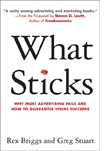
What Sticks by Rex Briggs and Greg StuartEvery book ever written about marketing will at some point dig up that old, familiar line: "I know half my advertising is wasted—I just don't know which half."

The quote shows up as expected (right off the bat, on Page 12) in the newly released What Sticks, by Rex Briggs and Greg Stuart. But while most authors treat this chestnut as a sad-but-true statement on the nature of the ad game, Briggs and Stuart (two marketing consultants) treat it more like a challenge. They argue that you can determine precisely which half of your advertising is wasted, if you'll just put in the effort. (Oh, and by the way, it's not really half. More like 37.3 percent, by their calculations.)

The underlying premise of What Sticks is that for too long, marketing has escaped hardheaded analysis. It's become (to use Briggs and Stuart's words) "illogical" and "faith-based." (For example, they recount a scene in which celebrity ad guy Donnie Deutsch assesses, before a large crowd of marketing pros, a Web-centric campaign he'd recently designed: " 'We got about 600,000 clicks. Was that great or was that not great? We told the client it was great, so it was great.' [Nervous laughter.]") Sensing that marketing is "broken," What Sticks resolves to take a clear-eyed, data-reliant, let's-fix-this-thing approach.


It feels almost revolutionary. The most successful marketing books these days tend to read like fuzzy-headed self-help guides. Look at last year's The Big Moo, in which currently hot (and wildly prolific) marketing guru Seth Godin compiles writing from several other famous business/marketing gurus (including Malcolm Gladwell, Tom Peters, and Guy Kawasaki). The Big Moo uses cocktail party anecdotes to illustrate how to do things like "remarkablize your organization." A little story about Harry Houdini's magic act is meant to teach us the value of "making an original choice when there seems to be no choice at all." A cute tale about the inventor of the "Apgar score" (a diagnostic test given to newborn babies) is meant to show us that sometimes you find breakthroughs in "the places you least expect." Other anecdote subjects (each enlisted to illustrate another highly unremarkable bromide): Rockport shoes, recumbent bicycles, and the fall of the Berlin Wall.

Why is this anecdote-laden style so popular with business authors, and so successful (to the tune of best-selling books and huge speaking fees)? I think it comes down to two things: 1) Fascinating anecdotes can, just by themselves, make you feel like you've really learned something. ("Hey, now I know what an Apgar score is, and where it came from! Who cares if this knowledge has zero application to my business?") 2) A skillful anecdote-wielder can trick us into thinking the anecdote is prescriptive. In fact, what's being sold is success by association. It's no coincidence that The Big Moo talks about the iPod—a recent mega-hit we're all familiar with—in at least three chapters. It's tempting to believe that bite-sized anecdotes about how the iPod was conceived, or designed, or marketed will reveal the secret formula for kicking butt with our own projects. Of course, it's never that simple. An anecdote is a single data point, and often a shaky one at that.

By contrast, What Sticks draws its prescriptions from a vast ocean of data points. Briggs and Stuart examined the marketing techniques of 30 major corporations, analyzed more than $1 billion in ad spending, and studied the effect of those ads on more than 1 million consumers. I'm in no position to assess their methodology here, but they've at least poured their faith into research and data, not catchphrases and stories. The book strives to find those parts of marketing that can be measured, and then to measure them. Yes, their conclusions are sometimes less than revelatory. (The first third of the book boils down to: Set specific goals for your advertising and then have regular meetings to assess your progress toward these goals.) But that's not to say they aren't good advice.

Consider the book's recommendations on media mix. Based on their research, Briggs and Stuart argue that an advertising message heard three different times in a single medium (for example, a television commercial you see three times) will be far less effective than a message experienced one time apiece in three different media (for example, as a TV commercial, then as a print ad, and then as an online banner ad). The numbers prove beyond doubt that this "surround-sound" approach is a winner. A few other data-based findings: It's generally better to show your product name and logo for the duration of an ad, not just at the very end. (Though Nike, famous for revealing the Swoosh logo only in the last moments of its TV spots, might disagree.) Also, the time of day can have a profound effect on a consumer's response to an ad (e.g., a McDonald's ad airing at lunchtime will be far more productive than one airing in the evening). And finally, online ads (and particularly large, intrusive ones) are far more effective than most people realize. (Remember that the next time Slate's whole home page turns into a hockey rink or a spaceport or whatever.)

Where What Sticks fails us is on the content side. Sure, the numbers can tell you where best to run your ads, and how often, and at what time of day. What they can't do, apparently, is tell you how to make your ads funny, or charming, or cool. It could be this doesn't even matter, and the important part is to get all the measurable stuff right. (Look at the HeadOn headache remedy ads, which simply repeat the product's name over and over, to the point of madness, and yet achieve their purpose more effectively than 99 percent of the witty/clever/stylish ads I see on TV.) Whatever the case, the book makes no attempt to solve the riddle of creativity.

Perhaps only anecdotes are suited to that job. So, I'll offer one of my own (and if this spurs you to pay me massive speaking fees, well, so be it):

In 1983, legendary screenwriter William Goldman wrote a book called Adventures in the Screen Trade. He offered tips on how to shape a script and recounted stories from his decades in the business. Having by this time written the screenplays for Butch Cassidy and the Sundance Kid and All the President's Men, it seemed that Goldman, better than almost anyone else, understood the recipe for Hollywood success. Yet despite Goldman's efforts to provide useful rules of thumb, and some constructive advice, the enduring legacy of Adventures in the Screen Trade remains a simple, three-word quotation.

Goldman's morsel of truth: "Nobody knows anything."


Check Out My Other Blogs (click on blog name to go there) = / 1.3rd Eye Blog / 2. Favorites Blog/ 3. Vita Excolatur (Living Well ...) Blog/ 4. Humor Me Blog/ 5. News and Current Events Blog/ 6. Consider This ... Blog/ 7. Consumer Warnings Blog/ 8. New Orleans Pentimento Blog/ 9. We Constant Gardeners Blog/ 10. Chaillot Family Blog/

Saturday, September 16, 2006

Politics as Show Buisness

Theater of War

Published: September 17, 2006

As a former theater critic, Frank Rich has the perfect credentials for writing an account of the Bush administration, which has done so much to blur the lines between politics and show business. Not that this is a unique phenomenon; think of Silvio Berlusconi, the media mogul and master of political fictions, or Ronald Reagan, who often appeared to be genuinely confused about the difference between real life and the movies. Show business has always been an essential part of ruling people, and so is the use of fiction, especially when going to war. What would Hitler have been without his vicious fantasies fed to a hungry public through grand spectacles, radio and film? Closer to home, in 1964, to justify American intervention in Vietnam, Lyndon B. Johnson used news of an attack in the Gulf of Tonkin that never took place. What is fascinating about the era of George W. Bush, however, is that the spinmeisters, fake news reporters, photo-op creators, disinformation experts, intelligence manipulators, fictional heroes and public relations men posing as commentators operate in a world where virtual reality has already threatened to eclipse empirical investigation.


Ray Bartkus

THE GREATEST STORY EVER SOLD

The Decline and Fall of Truth From 9/11 to Katrina.

By Frank Rich.

341 pp. The Penguin Press. $25.95.

Readers’ Opinions

Forum: Book News and Reviews

Ray Bartkus

Remember that White House aide, quoted by Rich in his introduction, who said that a “judicious study of discernible reality” is “not the way the world really works anymore”? For him, the “reality-based community” of newspapers and broadcasters is old hat, out of touch, even contemptible in “an empire” where “we create our own reality.” This kind of official arrogance is not new, of course, although it is perhaps more common in dictatorships than in democracies. What is disturbing is the way it matches so much else going on in the world: postmodern debunking of objective truth, bloggers and talk radio blowhards driving the media, news organizations being taken over by entertainment corporations and the profusion of ever more sophisticated means to doctor reality.

Rich’s subject is the creation of false reality. “The Greatest Story Ever Sold” is not about policies, or geopolitical analysis. The pros and cons of removing Saddam Hussein by force, the consequences of American military intervention in the Middle East and the threat of Islamist extremism are given scant attention. The author, an Op-Ed columnist for The New York Times, has his liberal views, which are not strikingly original. I happen to agree with him that Karl Rove and George Bush manipulated public fear and wartime patriotism to win elections, and that Dick Cheney and his neocon cheerleaders favored a war in Iraq long before 9/11 “to jump-start a realignment of the Middle East.” Whether Rich is right to say that this has “little or nothing to do with the stateless terrorism of Al Qaeda” is debatable. The neocons may well have believed that an American remake of the Middle East was the best way to tackle terrorism.

They were almost certainly mistaken. But the point of Rich’s fine polemic is that the Bush administration has consistently lied about the reasons for going to war, about the way it was conducted and about the terrible consequences. Whatever the merits of removing a dictator, waging war under false pretenses is highly damaging to a democracy, especially when one of the ostensible aims is to spread democracy to others. If Rich is correct, which I think he is, the Bush administration has given hypocrisy a bad name.

This is how the war was sold: We were told by Dick Cheney in late 2001 that an official Iraqi connection with the 9/11 terrorist Mohamed Atta was “pretty well confirmed.” In the summer of 2002, Cheney said that Saddam Hussein “continues to pursue a nuclear weapon” and that there was “no doubt” he had “weapons of mass destruction.” The vice president mentioned aluminum tubes (they had been reported on by Michael R. Gordon and Judith Miller in The New York Times), which Hussein would use “to enrich uranium to build a nuclear weapon.” This uranium, we were told, had been procured by the Iraqis from Niger. President Bush, in October 2002, said, “Facing clear evidence of peril, we cannot wait for the final proof — the smoking gun — that could come in the form of a mushroom cloud.”

We now know that none of these claims, which together constituted the official reason for unleashing a war, were even remotely true. The later excuses about honest beliefs based on faulty intelligence would have been more convincing if a memo had not surfaced from the British government, quoting the head of British intelligence as saying that the Bush administration had made sure that “the intelligence and facts” about the W.M.D.’s “were being fixed around the policy” of going to war. He said this in July 2002, eight months before the invasion of Iraq. Even without the memo, it has long been clear that some of the United States government’s own analysts had cast severe doubts on the reasons for going to war.

Yet — and this is where Rich is particularly acute — most serious papers published the White House claims on their front pages, and buried any doubts in small news items at the back. Political weeklies with a liberal pedigree, like The New Republic, fell in line with the neoconservative Weekly Standard, stating that the president would be guilty of “surrender in the war on international terrorism” should he fail to make an effort to topple Saddam Hussein. Bob Woodward, the scourge of the Nixon administration, wrote “Bush at War,” a book that seemed to take everything his White House sources told him at face value.

As soon as the fighting began, showbiz kicked in. Already in Afghanistan, the Hollywood producer Jerry Bruckheimer had been given access to the troops to make a television series about American bravery, even as reporters from papers like The Washington Post were kept away from the scene. Then in Iraq, heroic stories, like the brave battle of Pfc. Jessica Lynch, were invented and packaged for the press, and those who pointed out the fakery were denounced as leftist malcontents. President Bush dressed up as Tom Cruise in “Top Gun” and landed on an aircraft carrier for a photo op declaring a great victory. And the press, by and large, took the bait.

How could this have happened? How could some of the best, most fact-checked, most reputable news organizations in the English-speaking world have been so gullible? How can one explain the temporary paralysis of skepticism? This is perhaps the most painful question raised by Rich’s book, since his own newspaper was clearly implicated. An air of intimidation, which hung over the United States like a noxious vapor after 9/11, is part of the explanation. Susan Sontag became a national hate figure just for saying that United States foreign policy might have had something to do with violent anti-Americanism. When John Ashcroft declared to the Senate that people who challenged his highly questionable policies “give ammunition to America’s enemies,” he was simply echoing the ranters and ravers of talk radio. But they are poisonous buffoons. He was the attorney general. No wonder that the mainstream press, after being continuously accused of “liberal bias,” preferred to keep its head down.

Newspaper editors should not have to feel the need to prove their patriotism, or their absence of bias. Their job is to publish what they believe to be true, based on evidence and good judgment. As Rich points out, such journals as The Nation and The New York Review of Books were quicker to see through government shenanigans than the mainstream press. And reporters from Knight Ridder got the story about intelligence fixing right, before The New York Times caught on. “At Knight Ridder,” Rich says, “there was a clearer institutional grasp of the big picture.”

Intimidation is only part of the story, however. The changing nature of gathering and publishing information has made mainstream journalists unusually defensive. That more people than ever are now able to express their views, on radio shows and Web sites, is perhaps a form of democracy, but it has undermined the authority of editors, whose expertise was meant to act as a filter against nonsense or prejudice. And the deliberate confusion, on television, of news and entertainment has done further damage.

The Republicans, being more populist than the Democrats, have exploited this new climate with far greater finesse. Accusing the media of bias is an act of remarkable chutzpah for an administration that pitches its messages straight at radio talk show hosts and public relations men. Rich gives many examples. One of the more arresting ones is of Dick Cheney appearing on a TV show with Armstrong Williams, a fake journalist on the government payroll, to complain about bias in the press. Something has gone askew when one of the most trusted critics of the Bush administration is Jon Stewart, host of a superb comedy program. It was on his “Daily Show” that Rob Corddry, an actor playing a reporter, lamented that he couldn’t keep up with the government, which had created “a whole new category of fake news — infoganda.” Rich is right: “The more real journalism fumbled its job, the easier it was for such government infoganda to fill the vacuum.”

THERE may be one other reason for the fumbling: the conventional methods of American journalism, marked by an obsession with access and quotes. A good reporter for an American paper must get sources who sound authoritative and quotes that show both sides of a story. His or her own expertise is almost irrelevant. If the opinions of columnists count for too much in the American press, the intelligence of reporters is institutionally underused. The problem is that there are not always two sides to a story. Someone reporting on the persecution of Jews in Germany in 1938 would not have added “balance” by quoting Joseph Goebbels. And besides, as Judith Miller found out, what is the good of quotes if they are based on false information?

Bob Woodward, one of Rich’s chief bêtes noires, has more access in Washington than any journalist, but the weakness of his work is that he never seems to be better than his sources. As Rich rightly observes, “reporters who did not have Woodward’s or Miller’s top-level access within the administration not only got the Iraq story right but got it into newspapers early by seeking out what John Walcott, the Knight Ridder Washington bureau chief, called ‘the blue collar’ sources further down the hierarchy.” This used to be Woodward’s modus operandi, too, in his better days. Fearing the loss of access at the top and overrating the importance of quotes from powerful people, as well as an unjustified terror of being accused of liberal bias, have crippled the press at a time when it is needed more than ever. Frank Rich is an excellent product of that press, and if it ever recovers its high reputation, it will be partly thanks to one man who couldn’t take it anymore.

Ian Buruma is the Henry Luce professor at Bard College. His latest book is “Murder in Amsterdam: The Death of Theo van Gogh and the Limits of Tolerance.”


Check Out My Other Blogs (click on blog name to go there) = / 1.3rd Eye Blog / 2. Favorites Blog/ 3. Vita Excolatur (Living Well ...) Blog/ 4. Humor Me Blog/ 5. News and Current Events Blog/ 6. Consider This ... Blog/ 7. Consumer Warnings Blog/ 8. New Orleans Pentimento Blog/ 9. We Constant Gardeners Blog/ 10. Chaillot Family Blog/